The Oklahoma City Example
For twelve years, Oklahoma City contributed its police data to a LexisNexis data-sharing system. No clause in its contract restricted where that data could travel. In April 2026, after public pressure, the city council added one. This is the story of how that clause came to exist, and why it matters for every city running the same software.
Since 2014, Oklahoma City has run a regional police data warehouse. It now runs on LexisNexis software called the Accurint Virtual Crime Center, and fourteen area agencies feed it. The pitch was sensible: break down jurisdictional walls so neighboring departments can see the same information.
The problem was the fine print. Nothing in the contract said where Oklahoma City's contributed data could go once it entered the LexisNexis system, a system the company sells access to far beyond Oklahoma. As ICE ran the largest immigration operation in the country's history, residents started asking the obvious question: who else can access our city's police records?
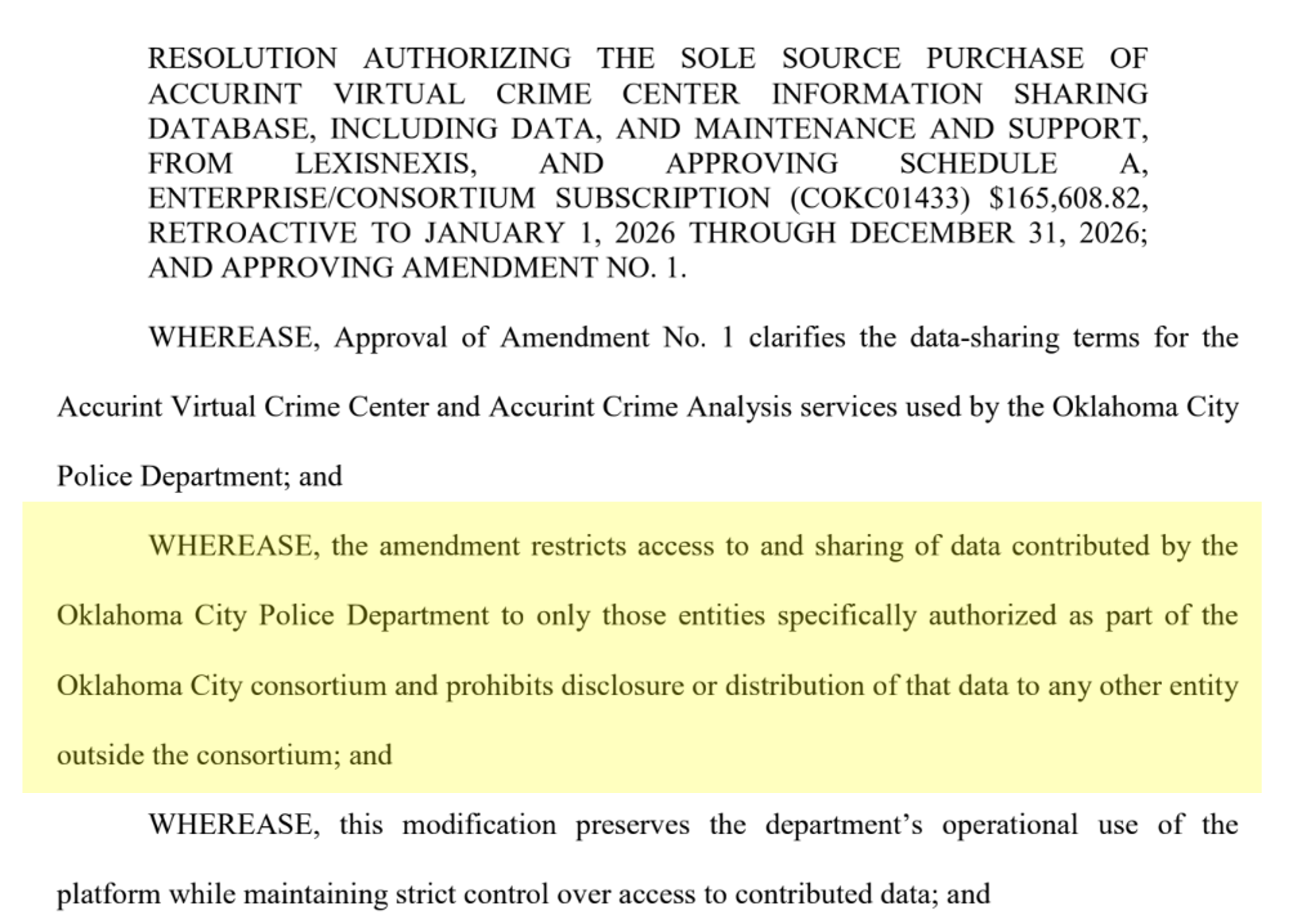
On April 21, 2026, the council renewed the software and added Amendment No. 1, which restricts sharing of Oklahoma City's contributed data to the city's own consortium and prohibits its distribution to any entity outside it. The city kept the tool, but fenced off the data so that only neighboring agencies could share records. In September 2026 the amendment itself came out through a public records request, along with a city email to council members: LexisNexis "agreed to all our requirements without changes." The full document is embedded below. Recognizing the problem, fixing it, and doing all of it through public records and open council debate is what makes Oklahoma City a useful example for other cities trying to take back control of where their residents' data goes: read what they have signed, push back in the open, and decide for themselves whether to fence the data or end the contract entirely.
A quiet decade, then a reckoning.
Every claim below comes from Oklahoma City's own procurement records, the signed LexisNexis contract, council meeting video, and local news coverage. The documents are linked at the bottom.
The Quiet Decade
A reasonable-sounding regional data warehouse, renewed every year as a routine sole-source item almost nobody read.
The data warehouse is born
After a competitive bid, the Oklahoma City Council approves a centralized data warehouse so contiguous agencies can pool and query each other's records. The stated goal is to break down traditional jurisdictional barriers. It runs on Bair Analytics software, hosted by the police department.
LexisNexis buys the vendor
LexisNexis Risk Solutions acquires Bair Analytics and agrees to keep hosting Oklahoma City's system. A local crime-mapping tool quietly becomes a node inside a national data broker's network. The product is rebranded over time as the Accurint Virtual Crime Center.
The city signs the standard addendum
Oklahoma City and LexisNexis Risk Solutions FL Inc. enter a Master Terms and Conditions Agreement (council Item VII.E.) with an Accurint Virtual Crime Center / Accurint Crime Analysis / Community Crime Map Addendum attached. We know this from the 2026 amendment, which names the addendum by date and identifies its Section II.1 License Grant as carrying "broader distribution rights." In the standard AVCC XML Addendum, Section II.1 is the clause that grants LexisNexis an irrevocable, worldwide license to everything the agency contributes.
FY2025
Renewed on autopilot
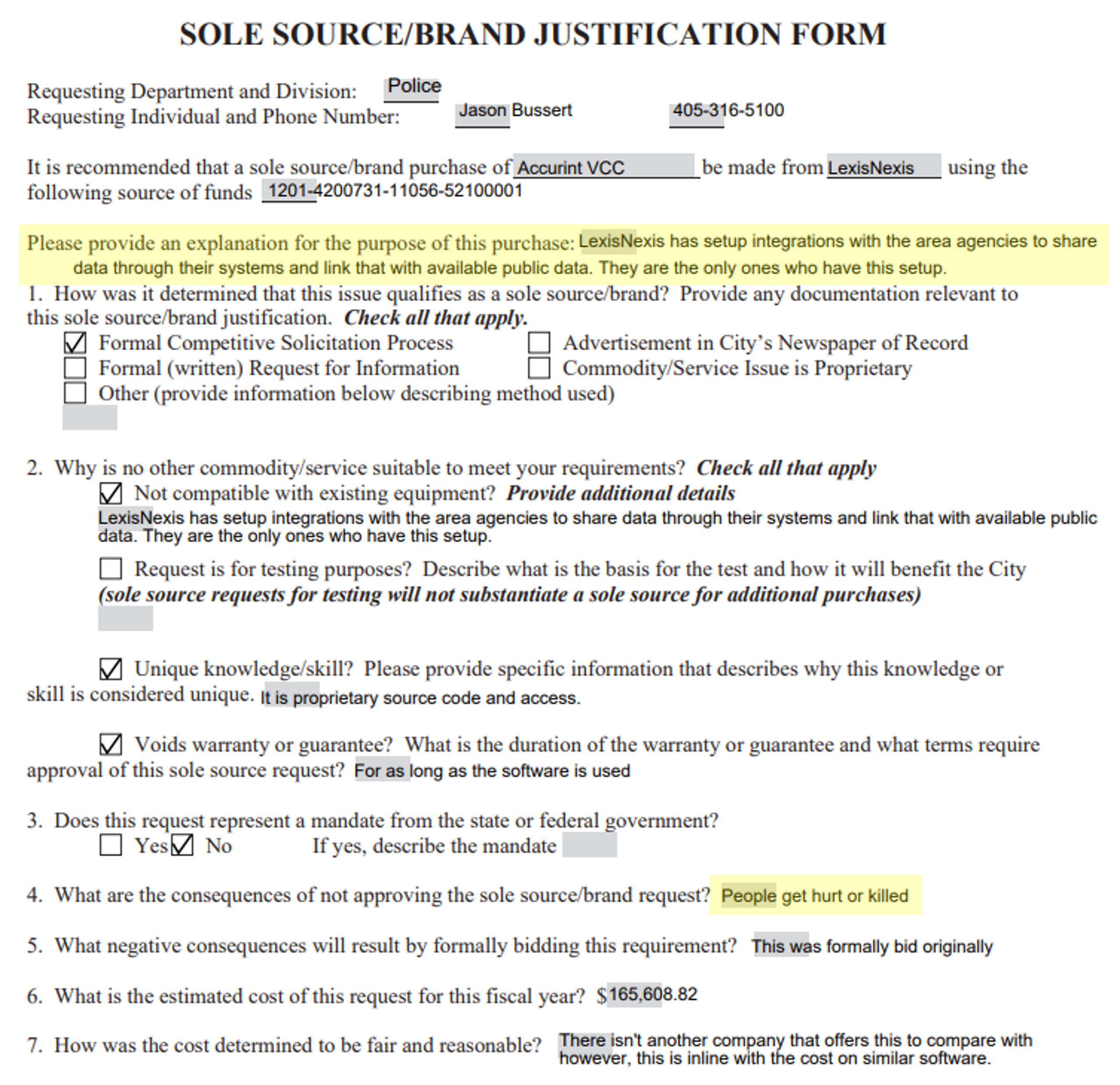
Oklahoma City migrates to the LexisNexis cloud-hosted Accurint Virtual Crime Center and renews the arrangement year after year as a sole-source purchase. The justification is consistent: LexisNexis is the only company that links integrated public-records searches to local law enforcement data, so there is nobody else to buy it from.
LexisNexis has setup integrations with the area agencies to share data through their systems and link that with available public data. They are the only ones who have this setup.
Asked on the same form what the consequences would be of not approving the purchase, the department's answer was five words.
People get hurt or killed.
The Reckoning
Against a national backdrop of aggressive immigration enforcement, the routine renewal stops being routine.
Feb 2026
The national backdrop: Operation Metro Surge
Roughly 1,000 miles north, ICE and Border Patrol run Operation Metro Surge across Minnesota, which the Department of Homeland Security calls the largest immigration enforcement operation ever carried out. The operation is national news for months. ICE has publicly described LexisNexis data as mission-critical to its deportation work. The connection is not lost on people in other cities running LexisNexis software.
The FY26 paperwork is filed
OKCPD files the sole-source documentation to renew the Accurint Virtual Crime Center for 2026. The signed Schedule A puts the annual subscription fee at $173,889.26 and lists fourteen agencies on the account. The council's own resolution cites a figure of $165,608.82 for the purchase. The two numbers do not match (see Sourcing & Notes).
A council member asks the question
During a council session, council member James Cooper raises the city's association with LexisNexis directly. The police chief speaks about Accurint and its investigative value. He does not mention that the city contributes data into the LexisNexis system, or where that data can travel once it does. The discussion touches both the Accurint platform and a separate LexisNexis citizen-reporting contract.
The press picks it up
Local outlets report that Oklahoma City is weighing crime-fighting software amid privacy concerns, putting the LexisNexis relationship in front of a wider audience and framing the renewal as a live civic question rather than a rubber stamp.
A civil-rights attorney names the pipeline; the vote is deferred
At the next meeting, council members sit down with the chief and IT staff. Deputy Chief Jason Sandall fields questions. A civil-rights attorney, Anna Nathanson, who says she has tracked the company since 2019, testifies that LexisNexis data is mission-critical to ICE deportations and that the city should not deepen a partnership with a company so closely entwined with federal immigration enforcement.
The item on the floor that night is a separate $67,500 LexisNexis Coplogic contract for a citizen online-reporting portal. Asked whether that data is shared with the federal government, police say no: the portal is closed, shared with no other entities, and purged after 90 days. Nathanson counters that the reporting tool is a data-collection product whose participant data is shared with other users on the LexisNexis platform, including ICE. The two accounts do not agree. The council defers the vote.
LexisNexis agrees to every term
Sixteen days after the deferral, a city official forwards a draft amendment to council members JoBeth Hamon and Camal Pennington. The city wrote the terms. LexisNexis took them as drafted.
LexisNexis agreed to all our requirements without changes in an amendment, which will be part of the contract, that we had agreed to previously but wasn't specifically called out. They will not share with anyone, other law enforcement, federal entities, etc. outside of our consortium which is comprised of the metro agencies.
The amendment inserts one new section, I(3)(c), into the 2019 addendum. It runs a page and a half. The full document, with the transmittal email, is below.
- Consortium-only access and use. LexisNexis must keep "administrative, technical, and contractual controls" so the city's contributed data is not "made accessible, disclosed, distributed, licensed, sold, transferred, or otherwise provided" to anyone outside the consortium, "whether through ACA, PSDEX, any successor database, any derivative product, any analytics output, or any data feed."
- No state or federal access. "Prevent nationwide sharing" is defined as no access by any non-consortium agency or user, "including any state or federal entity," absent the city's written authorization or valid legal process.
- Notice and veto. Any outside disclosure not compelled by legal process requires the city's prior written approval, "which may be withheld in Customer's sole discretion." Subpoenas, warrants, and records requests aimed at the city's data trigger prompt notice with a copy, cooperation on a protective order, and minimum disclosure.
- It overrides the license. Section 4 states the consortium-only restriction supersedes "any broader distribution rights in the Addendum (including Section II.1 License Grant)."
The renewal returns, with a fence attached
The Accurint Virtual Crime Center renewal comes back to the council as Agenda Item IX.D, presented by the city manager and the chief. This time it carries Amendment No. 1. After more pushback from the dais and the public, the council approves it. The amendment is the part that changes the story.
The amendment restricts access to and sharing of data contributed by the Oklahoma City Police Department to only those entities specifically authorized as part of the Oklahoma City consortium, and prohibits disclosure or distribution of that data to any other entity outside the consortium.
Same software. Two completely different data deals.
The Accurint Virtual Crime Center can be run two ways. The default exposes your residents' data to a national system. The Oklahoma City model keeps it home. Nothing about the software forces one or the other. It comes down to what your contract says.
Contribute to the national pool
- Your department's records feed the shared LexisNexis system.
- No contract clause limits which entities can access what you contribute.
- Access is sold by LexisNexis to customers well beyond your region, including federal agencies.
- Victim, witness, and suspect information can travel with the rest of the record.
- Your council and your residents may never see where the data goes.
Contribute to a named consortium only
- Your records stay inside a named consortium: not "accessible, disclosed, distributed, licensed, sold, transferred, or otherwise provided" to anyone outside it.
- The fence covers every channel: ACA, PSDEX, any successor database, derivative product, analytics output, or data feed.
- "Any state or federal entity" is outside the fence unless you authorize a specific disclosure in writing.
- Legal process gets notice, a copy, and cooperation on a protective order. Only the minimum is disclosed.
- The restriction overrides the addendum's Section II.1 license grant, in the contract and in a council resolution anyone can read.
The fence, drawn out
Oklahoma City's amendment restricts its data to the fourteen agencies on its own account. That roster is the consortium. Everyone inside the line can see the shared data. Nobody outside it can.
Source: signed LexisNexis Schedule A, Accurint Virtual Crime Center Online (Subscription), Customer: Oklahoma City Police Department, term Jan 1 – Dec 31, 2026.
The volume inside the fence
LexisNexis's own Community Crime Map lists 2,501,231 records uploaded by the Oklahoma City Police Department, with a last upload of August 12, 2026 and attempted homicide the only offense type not submitted. That is the scale of what the consortium restriction now governs: two and a half million incident records that, until 2026, sat under the addendum's broader license grant.
One question the amendment leaves open. Its title covers the Community Crime Map addendum, and its restriction reaches "any data feed." The public map runs on the same LexisNexis integration. We have not seen how the city squares the public map with the consortium-only clause.
Source: communitycrimemap.com, Oklahoma City Police Department agency panel, checked September 9, 2026.
You do not have to choose between a useful tool and your residents' privacy.
Oklahoma City is useful precisely because it is not a story about banning software. It is a story about reading a contract and changing one term. Here is the practical version for the two people most likely to be on this page.
Make the ask specific
- Get the contract itself, not the budget line. Ask for the signed Schedule A and any addendum by name. The order form alone doesn't contain the data sharing terms.
- Ask the questions that matter: "Do we share data with the national PSDEX exchange? Do we contribute data via our AVCC agreements, and if so, who has access to our city's police data?" If the answer is a description of the search tool, you have not been answered.
- Demand a ban, or a fence at least. Oklahoma City moved because council members and residents pushed back: against the claim that this was only a search tool, and against paying a company that supports ICE. The more they dug, the more they uncovered, until the police department put responsible restrictions in place itself in order to keep the product. Bring the Oklahoma City amendment with you. LexisNexis accepted it without changes, so "the vendor won't allow it" is no longer an answer.
- Put it on the record. Public testimony and press coverage are what moved the OKC timeline from January question to April amendment.
Scrutinize all of it. A ban is on the table.
- Read the whole paper trail. Pull every contract, schedule, and amendment tied to LexisNexis, including the renewals before this one. Ask staff directly: do we contribute data to the national PSDEX exchange? Is there any integration between AVCC or PSDEX and our RMS, CAD, or other records systems?
- Consider ending the contract. If your city has been feeding resident data into a private platform that sells access to ICE and other agencies, pulling the tool is a legitimate option. So is asking who authorized that, and holding them accountable.
- If you keep it, fence it. Introduce an amendment that prohibits sharing city police data with outside agencies through private platforms. At most, share with named local consortium members. The template below is Oklahoma City's actual contract language.
- Demand audit trails. Require records of who queries your city's data and how. Does it include juvenile data? Does it include sexual-assault victim data? Ask whether that information is shared with other agencies with no accountability, and whether you would ever vote to allow that.
- Make the limit public. Put the restriction in the resolution itself, so the next council, the next reporter, and the public can find it.
- Commission a study. Ask whether there are better ways to share and integrate systems with your neighbors than routing resident data through a private national database.
Template language
This is the operative language from Oklahoma City's amendment, with the agency and consortium names blanked. LexisNexis has already signed it once. Run it past your municipal counsel; the point is to name a closed set of authorized entities, forbid distribution outside it through every channel, and make the restriction override the addendum's license grant.
Insert a new Section I(3)(c) into the AVCC Addendum:

(c) LN will maintain data sharing restrictions that prevent
nationwide sharing while permitting access to [AGENCY]
and the [NAMED CONSORTIUM] agencies.

  1. Consortium-only access and use. LN will implement and
  maintain administrative, technical, and contractual controls
  such that Customer Data Contributions submitted by Customer
  (and Customer's consortium agencies) are not made accessible,
  disclosed, distributed, licensed, sold, transferred, or
  otherwise provided to any person or entity outside the
  [NAMED CONSORTIUM] (the "Consortium"), whether through ACA,
  PSDEX, any successor database, any derivative product, any
  analytics output, or any data feed, except as expressly
  permitted in this Section (c).
    a. "Prevent nationwide sharing" means no access by any
    non-Consortium agency or user, including any state or
    federal entity, unless Customer provides prior written
    authorization for the specific disclosure or the disclosure
    is required by valid legal process.

  2. Notice and approval for non-Consortium disclosures. LN
  shall provide prompt written notice to Customer before any
  disclosure or sharing of Customer Data Contributions outside
  the Consortium, including sharing with any governmental
  entity outside the Consortium, unless legally prohibited from
  providing notice. Any non-Consortium disclosure not compelled
  by legal process requires Customer's prior written approval,
  which may be withheld in Customer's sole discretion.

  3. Legal process. If LN receives any subpoena, court order,
  search warrant, public records request, investigative demand,
  or other legal process seeking Customer Data Contributions,
  LN shall provide Customer prompt written notice with a copy
  of the request before producing any information where legally
  permissible, cooperate with Customer to seek a protective
  order, and disclose only the minimum information legally
  required.

  4. The Consortium-only restrictions in this Section (c)
  supersede any broader distribution rights in the Addendum,
  including the Section II.1 License Grant, to the extent of
  any inconsistency.

[FinePrint addition, not in the OKC amendment:] This restriction
survives termination of the underlying subscription, and LN
shall delete Customer Data Contributions upon written request.
Sections (c)(1) through (4) track the amendment Oklahoma City adopted on April 21, 2026, lightly condensed; the full text is on DocumentCloud. The survival-and-deletion sentence is a FinePrint recommendation drawn from how these subscriptions handle data after cancellation; it is not part of the OKC amendment. Confirm all of it with counsel.
How we know what we know.
The amendment answers most of this. It modifies an AVCC Addendum dated January 2, 2019 and states that its consortium-only restriction supersedes "any broader distribution rights in the Addendum (including Section II.1 License Grant)." Section II.1 of the standard AVCC XML Addendum is the irrevocable, worldwide license to contributed data, and the amendment's stated purpose is to "prevent nationwide sharing." So the 2019 paper carried the standard contributory terms. What we cannot confirm is what actually happened to the data under those terms: the city's February email says the restriction "had been agreed to previously but wasn't specifically called out," which suggests some informal understanding existed. We have no document showing what that understanding was, or that it was honored. A city does not need to add a restriction to a system that was already restricted.
The document embedded above was released under Oklahoma City open records request ORR-5031-2026 (pages 063 to 066). It is the draft dated February 23, 2026, as forwarded to two council members on February 26, with blank signature lines. The council adopted Amendment No. 1 on April 21. The executed, countersigned copy was not in the production, and we have not seen who signed for LexisNexis. If the signed version differs from the draft, this page will be corrected.
The 2,501,231 figure comes from the Oklahoma City Police Department's agency panel on communitycrimemap.com, LexisNexis's public crime map, as displayed on September 9, 2026. The panel also shows a last upload date of August 12, 2026 and lists "Attempted Homicide" as the only incident type not submitted. The map's stated date range for contributed records begins in 1900, which is a data artifact, not a claim about 126 years of records. The figure counts records uploaded to the map product; we have not confirmed that it matches the volume contributed under the AVCC addendum.
The signed Schedule A states an annual subscription fee of $173,889.26. The council's sole-source documentation and resolution cite $165,608.82 for the purchase. We use the higher figure where we describe the contract, and flag the discrepancy here. The gap likely reflects a credit, a cost-share among consortium members, or a prior-year adjustment, but the records we have do not reconcile it. We are confirming through follow-up records.
The police department and the testifying attorney gave directly conflicting accounts of the Coplogic citizen-reporting portal. We report both and take neither as settled. The document that would resolve it is the Coplogic contract and its data-handling terms, which we are seeking.
FinePrint standard: every claim links to a primary source. AI-assisted research is flagged until independently confirmed. Document links marked as public records will resolve to hosted copies when this page goes live.