Ref. The Marketplace
Accurint Public Safety Marketplace
One login. One contract. A shelf full of surveillance tools. LexisNexis sells police agencies bundled access to Clearview AI, Babel Street, ShadowDragon and others through a single platform. The convenience is the pitch. The loss of oversight is the cost.
01What it is
A single storefront for surveillance.
Accurint Public Safety Marketplace is a storefront run by LexisNexis Risk Solutions. It collects third-party surveillance tools, facial recognition, social media monitoring, license plate data, aerial imagery, and sells agencies access to all of them through one platform.
In a promotional video published in May 2026, LexisNexis describes the pitch plainly. Agencies get tools, pre-screened by LexisNexis, through “one login and a single contract.” The company says this removes the administrative work of buying each tool on its own. A year earlier, a second LexisNexis video sold the same idea as “a single, powerful ecosystem,” claimed a 99.9% identity-match rate, and said thousands of agencies were already using it.
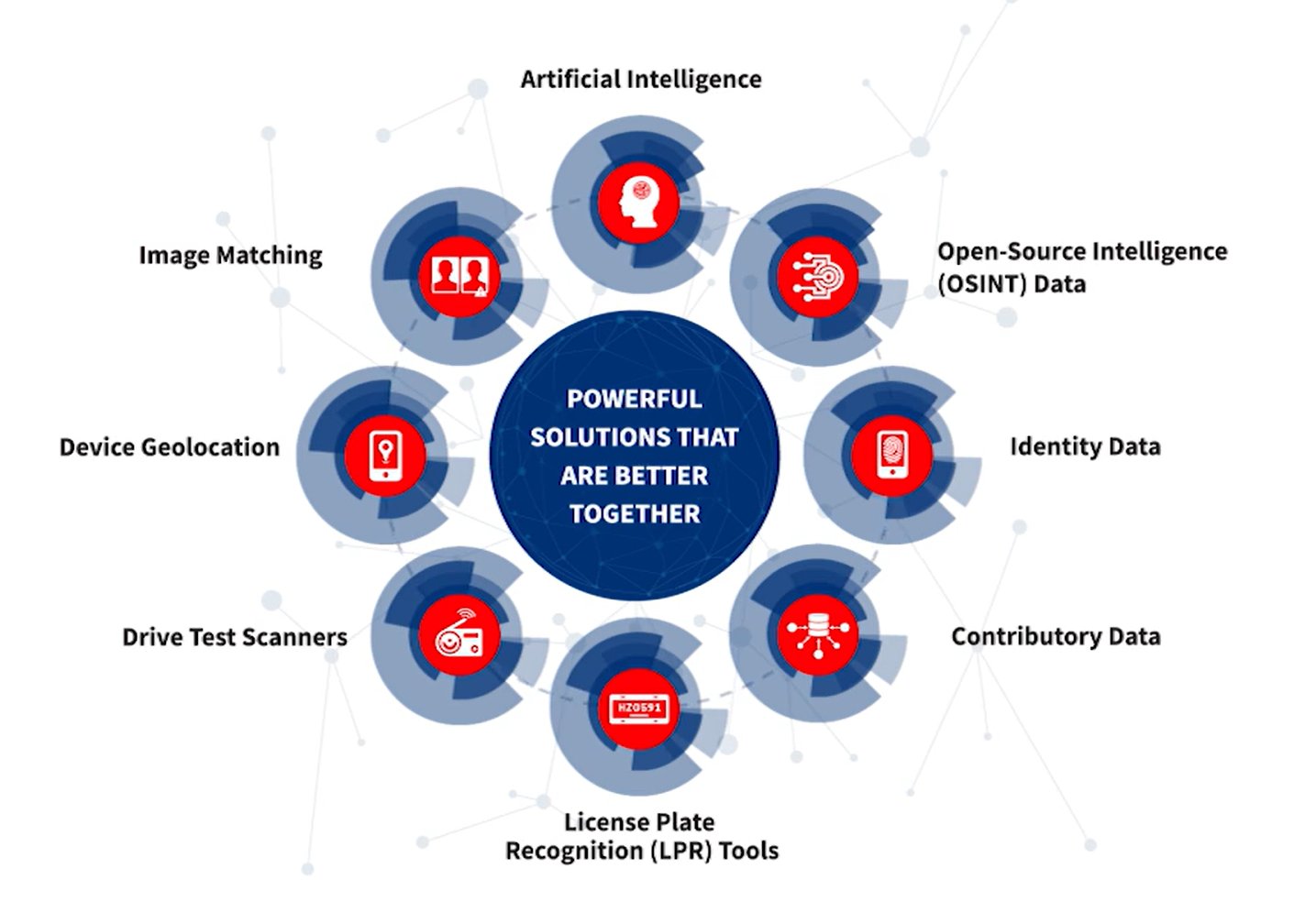
The selling point is convenience. An agency that wants facial recognition does not run a separate procurement, negotiate a separate contract, or stand up a separate login. It enables a tool inside a platform it already pays for. Single sign-on ties the tools together so an analyst moves between them without friction. The convenience is real. So is the cost to public oversight, which is the rest of this page.
02The roster
Who is on the shelf.
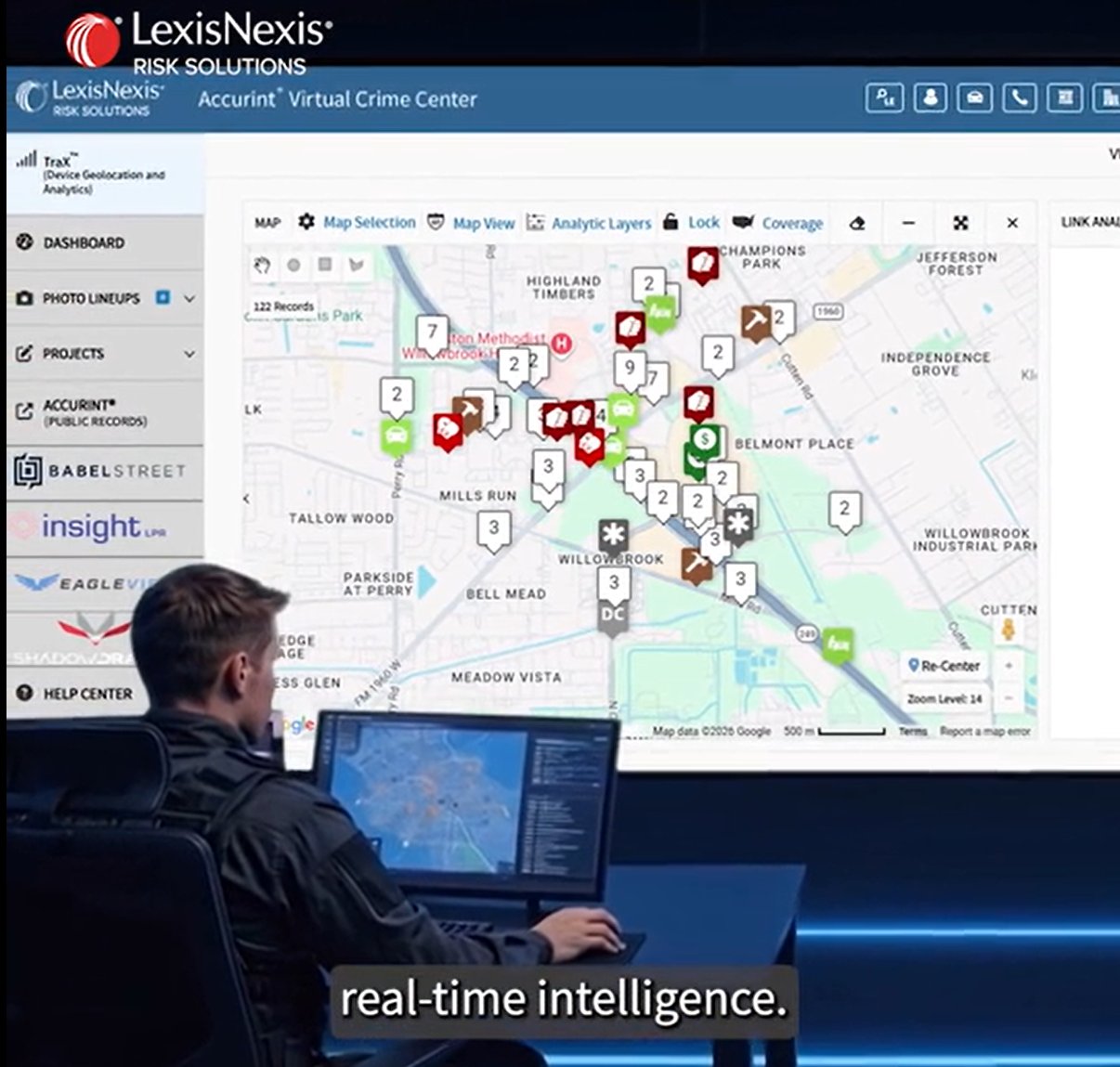
These vendors appear as integrations inside the Accurint environment and are offered to agencies through the marketplace. Each is a documented surveillance company in its own right.
Matches a face against billions of images scraped from the public web. Documented as available through the Accurint Virtual Crime Center in the Colorado Information Sharing Consortium’s May 2025 board minutes.
Aggregates social media, web data, and commercial device-location signals. Also documented in the CISC May 2025 minutes as available through AVCC for an added fee.
Maps a person’s online footprint across hundreds of platforms and builds timelines from open-source activity. Listed in the Accurint Virtual Crime Center integration panel.
Commercial license plate recognition. Surfaces where a vehicle has been seen across networked camera data. Listed in the AVCC integration panel.
High-resolution overhead imagery and property analytics. Listed in the AVCC integration panel.
The list is not fixed. The marketplace is built to add vendors over time, and this page will be updated as new tools and contract language are confirmed.
03The Marketplace Veil
Buying surveillance as a feature changes who sees the receipt.
When an agency contracts directly with a vendor, the accountability is visible. There is a public RFP, a council vote, a budget line item, and a contract a resident can request under public records law. The relationship runs from the agency to the vendor, and the public can follow it.
The marketplace replaces that chain with a longer one: agency to LexisNexis to vendor. The agency-to-LexisNexis contract may be public. The LexisNexis-to-vendor arrangement is a private commercial deal. What the agency actually bought, which capabilities, at what price, under what terms, may not appear in any public record at all.
Bundle ten tools into one contract and you collapse ten oversight checkpoints into one.The structural cost of single-contract procurement
Each separate purchase is a moment the public can intervene: an agenda item, a vote, a question from a reporter. A single contract reduces the number of those moments. The marketing calls this less administrative burden. From an oversight seat it reads as less friction on acquiring surveillance. Single sign-on compounds the effect. An analyst can move from a plate hit to a face match to a social media profile without leaving the platform, and often without a fresh authorization at each step.
FinePrint holds this as an open investigative question, not a settled finding. We are not claiming that every marketplace purchase escapes public notice. What we now know, from LexisNexis’s own marketing, is that the model is built around one login and one contract. What we do not yet know, in most jurisdictions, is whether council approval, public notice, and FOIA access still reach a capability that was switched on as a platform feature rather than bought as a standalone product. The incentive points one way. The documented answer is still missing. That gap is the story.
LexisNexis, “one login and a single contract.” Marketplace promo, published May 2026. Shown from an archived copy; original at vimeo.com/1196655867
LexisNexis, “a single, powerful ecosystem.” Earlier marketplace promo, 2025. Shown from an archived copy; original at vimeo.com/1068270727
04The concerns
Four ways the model erodes accountability.
These are the FinePrint lenses that bear on the marketplace. They describe different harms that grow from the same structure.
Lens · The Marketplace Veil
Procurement disappears into a platform
A capability acquired as an add-on may skip the RFP, the vote, and the public contract that a direct purchase would generate. The accountability machinery was built around buying things, not enabling features.
Lens · Complexity as a Shield
Too tangled to oversee
The chain runs agency to broker to vendor, with single sign-on hiding the seams. A system too complicated for a council to understand and too distributed for a journalist to map becomes effectively immune to oversight, without anyone choosing to make it so.
Lens · The Loophole
Buying what you cannot build
Capabilities a government might be constrained from running directly, face recognition on scraped images, warrantless location tracking, become a purchase. A private vendor is not bound by the same limits, and buying access is not the same legal act as conducting the surveillance.
Lens · The Aggregation Threshold
The fusion is the product
The marketplace’s value is the join. One login that fuses plate data, face matches, social media and aerial imagery produces a profile no single tool would, and that no single privacy law clearly governs.
05The record
What is documented, and what is still open.
FinePrint separates what we can source from what we are still chasing. Here is where this page stands.
Documented
- ✓LexisNexis markets the marketplace as one login and one contract (promo video, May 2026).
- ✓The pitch centers on reduced administrative work and single sign-on across tools.
- ✓LexisNexis claims a 99.9% identity-match rate and “thousands of agencies” using it (its own figures, 2025).
- ✓Clearview AI and Babel Street are available through AVCC for added fees (CISC board minutes, May 2025).
- ✓The AVCC interface integrates Babel Street, Insight LPR, EagleView and ShadowDragon (marketing screenshot).
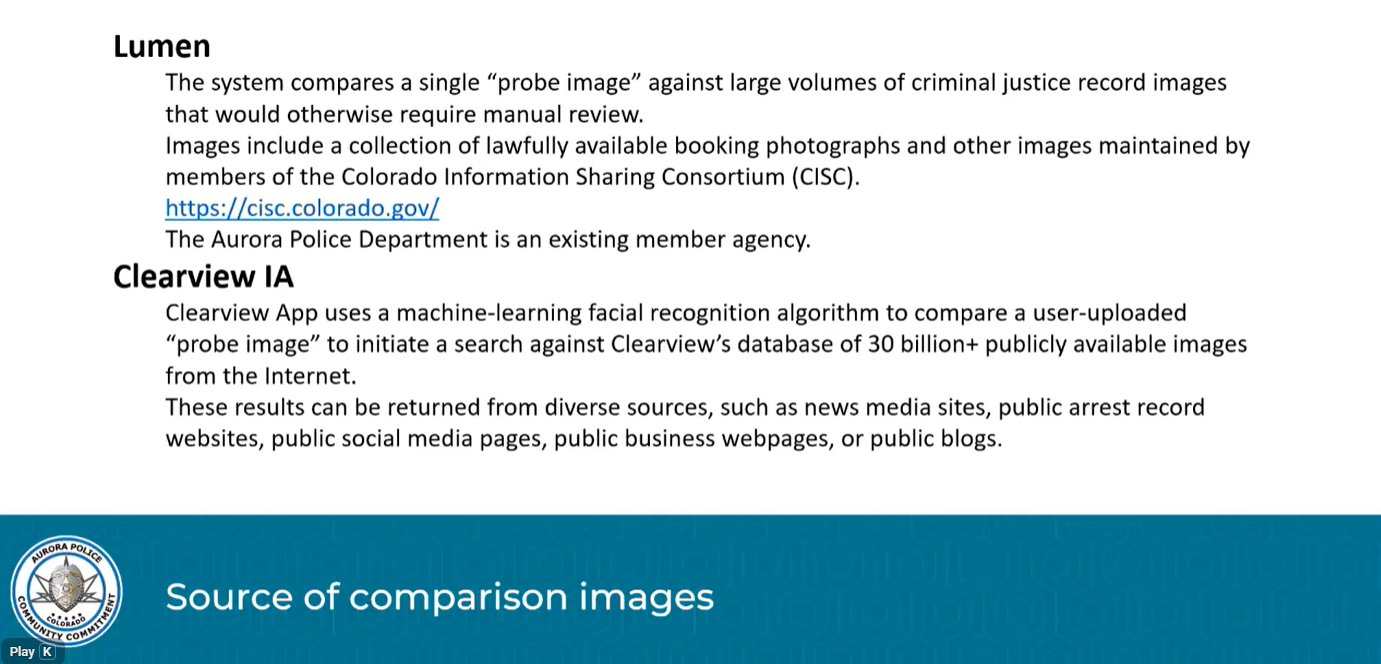
- ✓Aurora, Colorado PD activated facial recognition in Lumen/AVCC and can match probe images against both CISC booking photos and Clearview AI via the marketplace (Aurora PD accountability report, 2026).
Open questions
- ?Do marketplace add-ons trigger council approval or public notice in a given jurisdiction?
- ?What does each tool cost? Itemized pricing is not public.
- ?Which agencies have enabled which tools?
- ?Who inside an agency can switch on a tool, and at what level of authorization?
- ?Do the LexisNexis-to-vendor terms impose use limits the buying agency can see?
06A documented example
Aurora, Colorado: the marketplace, switched on.
In 2026 the Aurora Police Department activated facial recognition inside the Lumen/AVCC platform it already subscribed to through the Colorado Information Sharing Consortium. The department filed a public accountability report describing exactly what it turned on, the rare primary record of a marketplace capability being switched on.
Per Aurora’s own report and briefing slides, a single “probe image” can be run two ways. The first is against booking photographs and other law-enforcement images held by the 140-plus member agencies of CISC, matched by Rank One Computing’s algorithm inside Lumen/AVCC. The second is against Clearview AI’s database of, by the company’s own count, 30 billion-plus images, reachable through the Public Safety Marketplace. One subscription, two very different pools of faces.
Read Aurora PD’s Facial Recognition Accountability Report (PDF) →
Clearview AI is a private company that scrapes (many would claim “steals”) photos from various websites. The company built its database by scraping images from the public web and social media without the consent of the people in them, or the websites hosting them. This has created a long line of legal challenges. In 2020, Google, YouTube, Facebook, Twitter, Venmo and LinkedIn each sent cease-and-desist letters demanding Clearview stop harvesting their users’ photos in violation of their terms of service. In 2022, a settlement with the ACLU under Illinois’ Biometric Information Privacy Act permanently barred Clearview from selling its faceprint database to most private entities nationwide. In 2025, a federal court approved a $51.75 million class-action settlement over allegations the company had illegally collected the biometric identifiers of millions of people without consent. Privacy regulators in the United Kingdom, France, Italy, Greece and Australia have separately found its collection unlawful and issued fines.
The faces in Clearview’s set were taken, not given. Most belong to people who were never arrested, charged, or suspected of anything; they are in the database only because a photo of them once appeared online. Generating investigative leads by matching against a pool assembled this way means a police search can be powered by data that courts and regulators have repeatedly called unlawfully collected, and the people in it never agreed to stand in anyone’s lineup.
A note on why Aurora
We use Aurora as the example because the department chose to be transparent. It published a memo, briefed the change in two public presentations (video 1, video 2), and filed a formal accountability report under Colorado law. They went beyond what was required for transparency. Most agencies that enable a Public Safety Marketplace tool leave no comparable public trace, and nothing about how the system is set up requires them to.
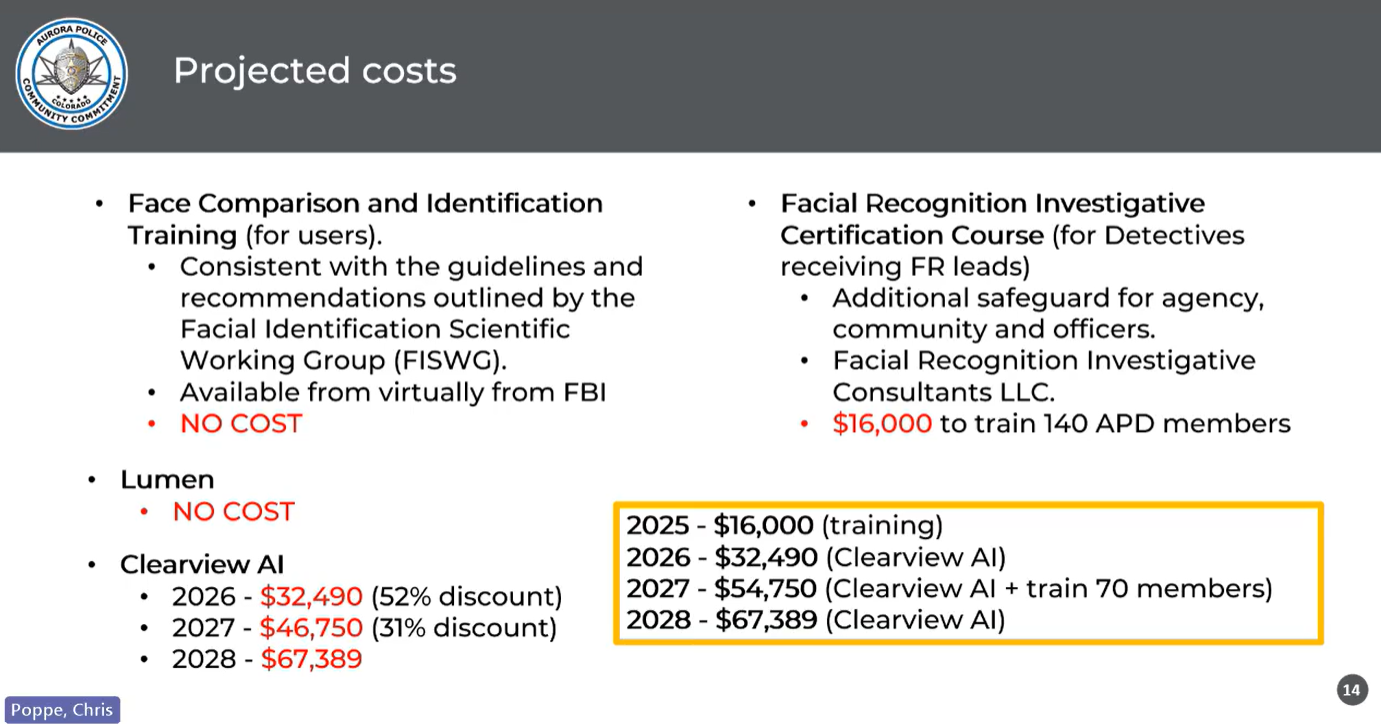
Aurora’s openness should be met with credit, not penalty. The point of this section is not that Aurora did something unusual by turning the facial recognition feature on; it is that Aurora did something unusual by being transparent. The marketplace is designed so the next department doesn’t have to. By 2028, Aurora PD plans to pay over $67,000 per year to access this scraped data.
07 For local journalists
What to request.
If a department in your area subscribes to Accurint, the Virtual Crime Center, or the Public Safety Marketplace, these requests narrow the open questions above.
- →Itemized billing or invoices, broken out by individual tool or add-on, not a single lump line.
- →All communications with LexisNexis sales staff or account managers about marketplace integrations or add-ons.
- →Any internal policy governing which marketplace tools can be enabled, by whom, and with what approval.
- →The full contract with every schedule, addendum, and order form attached, not just the signature page.
If you have a marketplace order form, an itemized invoice, or a council agenda that names any of these tools, send it. Every document closes the gap a little more.
Send a tip →A note on sourcing. The factual claims on this page come from LexisNexis marketing materials (linked above), the Accurint Virtual Crime Center interface, the Colorado Information Sharing Consortium’s May 2025 board minutes, and, for section 06, the Aurora Police Department’s own facial recognition accountability report and briefing slides (linked above). The Clearview AI litigation history in section 06 reflects public court and regulatory records, including the 2020 cease-and-desist letters, the 2022 ACLU/BIPA settlement, and the $51.75 million class-action settlement approved in 2025. The accountability analysis in sections 03 and 04 is structural inference about how the marketplace is built, kept separate from the sourced facts. Vendor performance claims, including the 99.9% match figure and the “thousands of agencies” count, are LexisNexis’s own and are reported here as the company’s claims, not as findings verified by FinePrint.