The Accurint Files — Act One
The Contractor in the Middle
How a Dutch publishing giant became the gatekeeper of American police records.
Local police records — victim names, 911 calls, and incident reports — sold to ICE, the military, and thousands of law enforcement agencies across the country. With no public vote.
0
Law enforcement agencies
contributing data
$22.1M
Federal contract
paid by ICE
267M+
Americans with a profile
in the database
In the months after September 11, 2001, a 50-year-old former drug pilot named Hank Asher sat down in his Boca Raton, Florida mansion and decided he was going to help the federal government find the next set of hijackers. Asher was, by then, a self-taught programmer and the founder of a data company called Seisint. He had spent the 1990s building tools that fused together every public record about an American — every mortgage, every license plate, every traffic ticket — into a single dossier. Two days after the attacks, he told one of his houseguests, a retired Drug Enforcement Administration agent, that he could find the hijackers' co-conspirators. Within months, he and a handful of state law-enforcement officials had built a system they called MATRIX, the Multistate Anti-Terrorism Information Exchange.
When the public found out about MATRIX, several state governors pulled their states out of the consortium. The American Civil Liberties Union sued. Federal funding evaporated. By 2005, the program was dead.
Its underlying engine was not. In July 2004, the legal-research firm LexisNexis paid $775 million for Asher's company. LexisNexis was then a unit of Reed Elsevier, an Anglo-Dutch publishing conglomerate that has since rebranded as RELX. The acquisition gave LexisNexis the database engine that powered MATRIX, and a consumer-facing search product Asher had built alongside it called Accurint.
Two decades later, Accurint is no longer a single product. It is a sprawling platform sold to law enforcement under names like the Accurint Virtual Crime Center (AVCC), the Accurint Public Safety Marketplace (PSM), and the Accurint Crime Analysis Workstation (ACAW). According to LexisNexis Risk Solutions' own June 2024 press release, more than 2,100 American law enforcement agencies now contribute their internal records to a single LexisNexis database called the Public Safety Data Exchange, or PSDEX. Those records include incident reports, 911 dispatches, jail bookings, names, addresses, dates of birth, vehicle information, and free-text narrative fields. The data is sold back to other police departments and to a growing list of federal customers. The largest and most documented federal customer is U.S. Immigration and Customs Enforcement, which signed a $22.1 million contract for access in February 2021.
An interactive explainer
The Data Journey
How one ordinary interaction with local police becomes a permanent, federally-searchable record — and the person never knows.
01 / 06
It starts with something ordinary
A person calls 911 to report a break-in. Or witnesses a car accident and gives a statement. Or files an online report for a stolen bike. They are not a suspect. They are not under investigation. They are simply someone who came into contact with the police.
02 / 06
The report becomes a record
Their name, address, phone number, and the narrative of what happened are entered into the department's internal records system. So far, this is normal, expected, and useful. This is what records systems are for.
03 / 06
Private Data Harvesting
Thousands of local departments have signed an agreement with LexisNexis, which creates a pipeline between local police records and a privately-owned database in the cloud. With the agreement in place, LexisNexis automatically copies local police data. As the data leaves city systems, it gets sent to LexisNexis every 15 minutes to 24 hours. It is a data copying pipeline most residents never hear about.
04 / 06
Now it's in the national pool
The record lands in the Public Safety Data Exchange (PSDEX), alongside data from roughly 2,100 other cities. There it is linked to other personal data including voter registration, vehicle registration, utility records, phone information, social security number, email addresses, and social media profiles.
05 / 06
Searchable to whoever LexisNexis sells access to
Investigators at any of the 2,100 contributing agencies, and many more non-contributing agencies, pay LexisNexis to search these records. No search warrant, subpoena, or reasonable suspicion required. Federal agencies pay for access as well, including the military (Navy), Food and Drug Administration, State Department, and Department of Agriculture. ICE pays $22.1 million for access. The person who called 911 is never notified, and cannot see who looked them up. Even the city police department that gave the data to LexisNexis cannot see who used it, or how it was used.
06 / 06
And it doesn't come back
Under the contract, LexisNexis holds a license and owns the contributed data, even if the department cancels their contract, even if a citizen opts out or requests their data be deleted. By LexisNexis's own policy, the ability of consumers to opt out does not apply to products used by law enforcement. Once a city lets their data get copied, they cannot control it, they cannot audit how it is used, and they cannot remove it.
One interaction. One record. A permanent place in a national, private-sector database searched by military, federal, and local agencies with no relation to the local incident.
If you were the victim of a crime in one of those 2,100 jurisdictions, your name is probably in there. If you witnessed a car accident and gave the responding officer your phone number, your name is probably in there. If you submitted an online theft or property-damage report through your local police department's website, your information is likely in there too, because most online police-report portals in the United States run on LexisNexis Coplogic software, which feeds citizen-submitted reports into PSDEX as well as into the agency's own systems. If a neighbor has called the police on you repeatedly for noise or for a perceived nuisance — even calls the responding officer wrote off as unfounded — your name is in there. And if you were ever arrested, regardless of whether the charges were sustained, your booking photo sits in the database alongside the facial-recognition tools available through the Accurint Public Safety Marketplace. The contract that put each of these records there was almost certainly signed by your city council or sheriff's office as a line item in a routine procurement vote, without a public debate.
You do not have to be a suspect.
You do not have to be arrested. You do not even have to call 911 yourself. Being mentioned in a contributing department's record system is enough: as a victim, a witness, a reporting party, a co-resident at an address an officer visited, a neighbor who got named in a report you never saw, or the registered owner of a vehicle pulled over by someone else. Once your name lands in an RMS narrative field, it gets uploaded along with everything else.
For immigrants — including legal residents and U.S. citizens with mixed-status families — the implication is the same in every state. A jurisdiction can pass the most aggressive sanctuary law in the country, refuse to honor ICE detainers, prohibit local officers from inquiring about immigration status, and still have its police records automatically funneled to a database that ICE pays $22.1 million to search. This is the case in Cook County, Illinois. It is the case in dozens of California cities. It is the case across Colorado. It is true regardless of which party controls the local government, and it is the structural fact at the center of this investigation.
None of this had to be built this way. The 18,000 American police agencies that produce these records can already share them with each other directly, through the FBI's National Data Exchange and a range of regional fusion centers built for exactly that purpose. Instead, 2,100 of them route their data through a private corporation owned by RELX, the Anglo-Dutch publishing giant whose risk-and-analytics division is now the company's largest and fastest-growing business, generating roughly £3.3 billion (about $4.2 billion) in annual revenue as of 2024. ICE pays that corporation $22.1 million for access. Contributing agencies, having uploaded their data for free, then pay LexisNexis tens of thousands of dollars apiece in annual subscription fees to search the database their own records helped fill. Whether the same agencies could collectively build a non-commercial equivalent — with public oversight and no ICE pipeline — is a question almost no city council has been asked.
How We Got Here
The platform now branded as Accurint did not begin as a law-enforcement product. It began as a way to sell journals to scientists.
In 1880, a Dutch publisher named Jacobus George Robbers founded a science-publishing house called Elsevier in Rotterdam. In 1895, a British engineer named Albert Reed bought a newsprint mill in Tunbridge, Kent. Over the next century, both companies grew, merged with competitors, and absorbed dozens of smaller publishers. In 1993, Reed International and Elsevier merged with each other, forming an Anglo-Dutch conglomerate then called Reed Elsevier and, after a 2015 rebranding, RELX.
In 1994, Reed Elsevier acquired LexisNexis, an Ohio-based legal-research company that had pioneered electronic case-law search in the 1970s through a project originally funded by the U.S. Air Force. LexisNexis had been the first commercial information service to put a large, searchable database in front of non-specialist end users. For Reed Elsevier, the appeal was straightforward: LexisNexis was a subscription business with millions of documents already indexed, and a growing line of public-records products aimed at lawyers, investigators, and insurance companies.
For about a decade, that was a legal-research business. Then came 9/11, and then came Hank Asher.
Asher had founded his first data company, Database Technologies, in the early 1990s. Its flagship product, AutoTrack, sold investigators access to a fused dataset of vehicle registrations, address histories, and public filings. In 1999, after Forbes and the South Florida Sun-Sentinel surfaced his early life as a drug pilot — Asher admitted to flying loads from Colombia and Belize during a seven-week stretch in 1982, before turning himself in and becoming a DEA informant — federal agencies suspended their contracts with the company. Database Technologies' board bought him out for $147 million, and the company was sold to ChoicePoint. Asher started over almost immediately, founding Seisint in 1999. Seisint's main product was Accurint, the next-generation public-records search engine that built on AutoTrack's design.
After 9/11, Asher pitched his data-fusion technology to the FBI, several state governments, and the newly created Department of Homeland Security. He helped construct MATRIX as a Florida-led counterterrorism consortium that 13 states initially joined. Civil-liberties groups objected. State legislatures pulled funding. By 2004, only Connecticut, Florida, Ohio, and Pennsylvania remained. Asher had resigned from Seisint's board in late 2003 under pressure from investors worried about his drug-running past. The following July, Reed Elsevier's LexisNexis division bought Seisint outright for $775 million. Asher's personal take was roughly $250 million. MATRIX shut down in 2005. Accurint did not.
The 2004 acquisition is the inflection point of this story. Asher's data engine — the part the public had rejected — was now embedded inside a publicly-traded multinational with a respectable legal-research brand. The product kept its name. The contracts kept getting signed. The civil-liberties debate moved on.
The risk-and-public-records business then kept consolidating. In 2008, Reed Elsevier paid roughly $4 billion to acquire ChoicePoint, the same data broker that had previously bought out Asher's earlier company. (ChoicePoint had by then been implicated in a high-profile 2005 breach that exposed personal information on roughly 145,000 Americans; the FTC fined the company $15 million.) The two companies' data assets were merged. In 2009, the combined unit was renamed LexisNexis Risk Solutions; in 2011, it was launched as a standalone subsidiary of what is now RELX. Today, LexisNexis Risk Solutions is headquartered in Alpharetta, Georgia, and sits inside what RELX calls its Risk segment — its largest and fastest-growing division by underlying revenue growth in 2024.
Hank Asher, for his part, went on to found a third data company, TLO, before dying of a heart attack in January 2013. TLO's data assets were acquired by TransUnion the following year for $154 million in a bankruptcy-court sale, and the product still sells today as TLOxp. Accurint's largest direct competitor in the law-enforcement market is Thomson Reuters' CLEAR — a separate platform with no Asher lineage; ICE pays for that one too. McKenzie Funk's 2023 book The Hank Show is the definitive account of Asher's life and the industry he created.
LexisNexis Risk Solutions did not immediately build a product for street-level police work. The Accurint that ICE began using under the Obama administration was largely the same Accurint Asher had built: a powerful person-search tool that bundled DMV records, utility-account data, property records, telephone listings, and credit-header data into a single dossier. Its transformation into a true contributory police-records platform — in which local agencies upload their own internal data rather than just searching LexisNexis's commercial dataset — happened in stages over the next decade and is mostly the work of acquisitions.
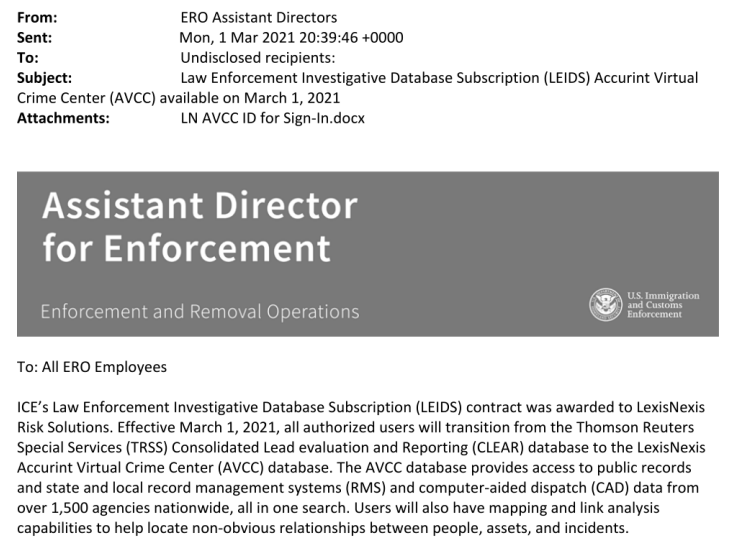
An internal ICE email sent March 1, 2021 — the day AVCC access went live — announcing the transition to all Enforcement and Removal Operations employees. The email confirms ICE understood it was gaining access to “state and local record management systems (RMS) and computer-aided dispatch (CAD) data from over 1,500 agencies nationwide, all in one search.” Source: ICE FOIA release, December 2021
The 2,100-agency figure is the one this story is principally about. It does not refer to agencies that subscribe to Accurint — there are several times that many. It refers to agencies that, by signing one or more boilerplate addendums to a standard LexisNexis order form, have agreed to grant LexisNexis a "paid up, irrevocable, worldwide, non-exclusive license" to ingest their internal records on a recurring schedule and to redistribute those records to LexisNexis's other customers, including ICE. The quoted language appears verbatim in the customer agreements signed by police departments in Clear Creek County, Colorado and dozens of other jurisdictions whose contracts have been obtained through public-records requests.
That license is at the center of everything that follows.
The Accurint Files · Data Pipeline
What Gets Collected — and Where It Goes
↓ Click any node to learn more
How the system works
A private database fed by public police departments
When a police department signs a contract with LexisNexis, it agrees to upload its internal records automatically. Every category on the left goes into a private company’s database. Click any node to see what it means for you.
Coming soon
Act Two — How They Built the Machine
The mechanism behind the exchange — how the contracts are written, what the license actually takes, and how 2,100 departments ended up feeding the same private pool.